 Quasi
QuasiSay it,
hear it done.
Quasi is a small experiment in computing without a screen. You speak into a pocket recorder while your phone stays locked and in your bag. A few short sounds from your phone tell you that you were heard, understood, and that the thing you asked for is done.
The sound language
An aural language for screen-free life
Without a screen, you still need feedback. That's why Quasi speaks to you with a small vocabulary, so you know what it's doing and when it's done. Each word has its own sound, and the sounds are easy to learn.
Example 1: A voice note turns into two tasks
Quasi's vocabulary used here
More examples
Every voice note is the same short sentence of sounds. What changes is how the sentence ends, or where it breaks off.
What it does
The screen is for afterwards.
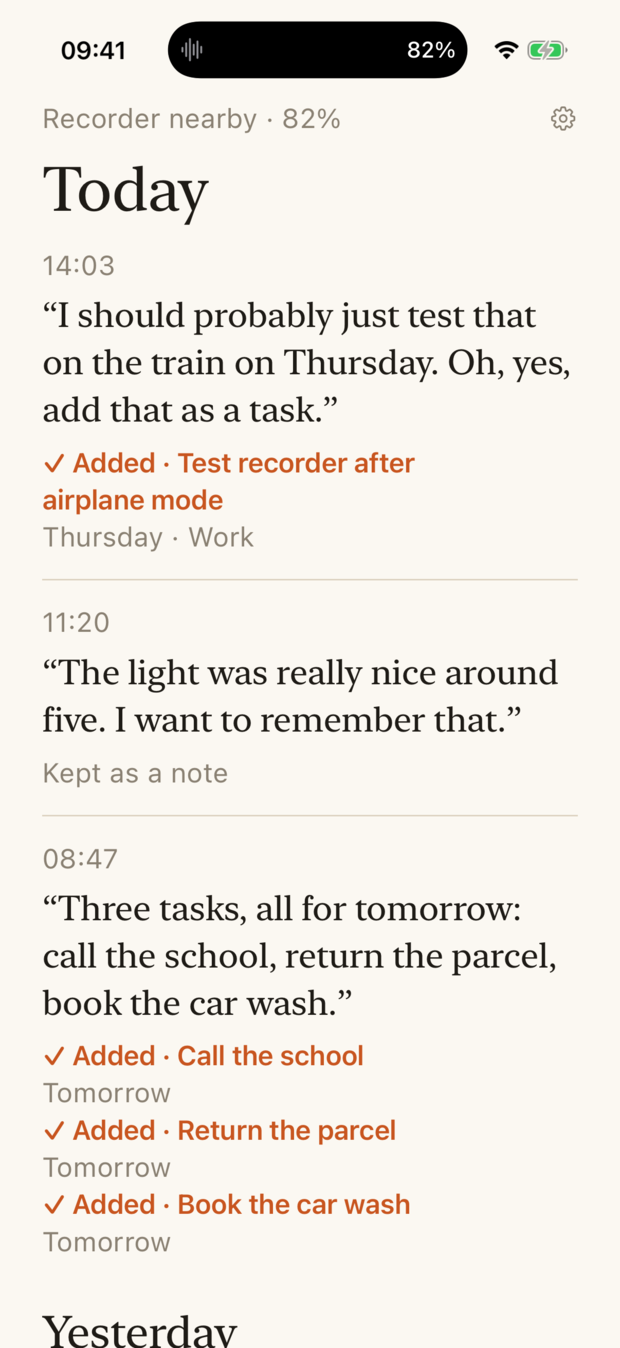
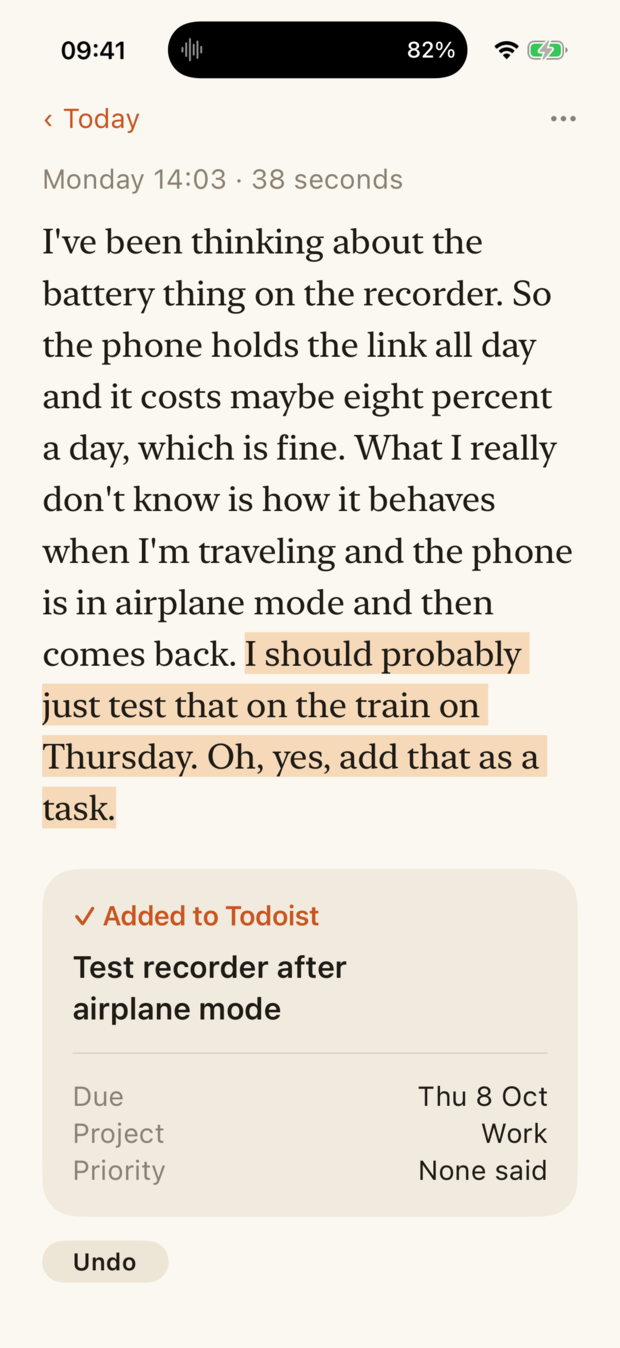
Press the button on the recorder and talk the way you think: rambling, correcting yourself, changing your mind. Somewhere in there you say "add that as a task", or list three things for tomorrow. When you stop, your phone has already transcribed the note, worked out what you asked for, and put it in your to-do list.
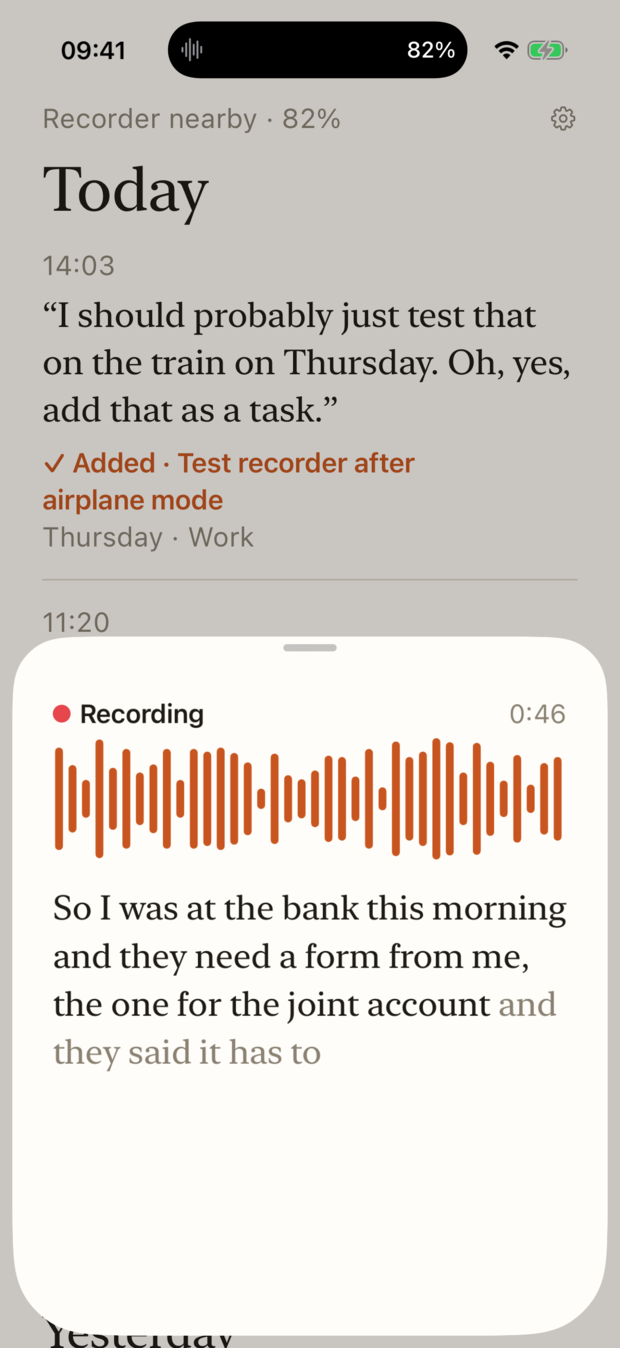
The app is where you check what happened, not where things happen: your words in a serif, the app's in plain type, and one orange that only ever means "I did something".
On the Lock Screen
If you do want a glance without unlocking, a banner on the Lock Screen shows what Quasi is doing. It has six states.
Why
Nothing to look at.
The tools that can finally understand what we mean still ask us to stare at glass to use them. Quasi is a guess at the other direction: a button to press, your own voice, and sound coming back. The recorder is the interface. The phone is a quiet machine in a bag.
It is called Quasi because you speak as if someone were listening.
What it is, plainly
An experiment, not a product.
- It needs a specific recorder. It was built for one Comulytic Note Pro, by its owner, and has been tested with exactly that one.
- The phone has to be on and nearby. A phone that is locked, dark and in another room is fine. A phone that is switched off or out of Bluetooth range is not.
- It needs your own keys. Transcription happens on the phone. Finding the tasks uses Claude, and adding them uses Todoist, each with a key you supply. Those are the only places your words leave the device.
- It is not in the App Store. There is an iPhone app and a Mac menu bar app; you build them yourself with Xcode.
The source is on GitHub, under the GNU General Public License, version 3.