what claude was asked
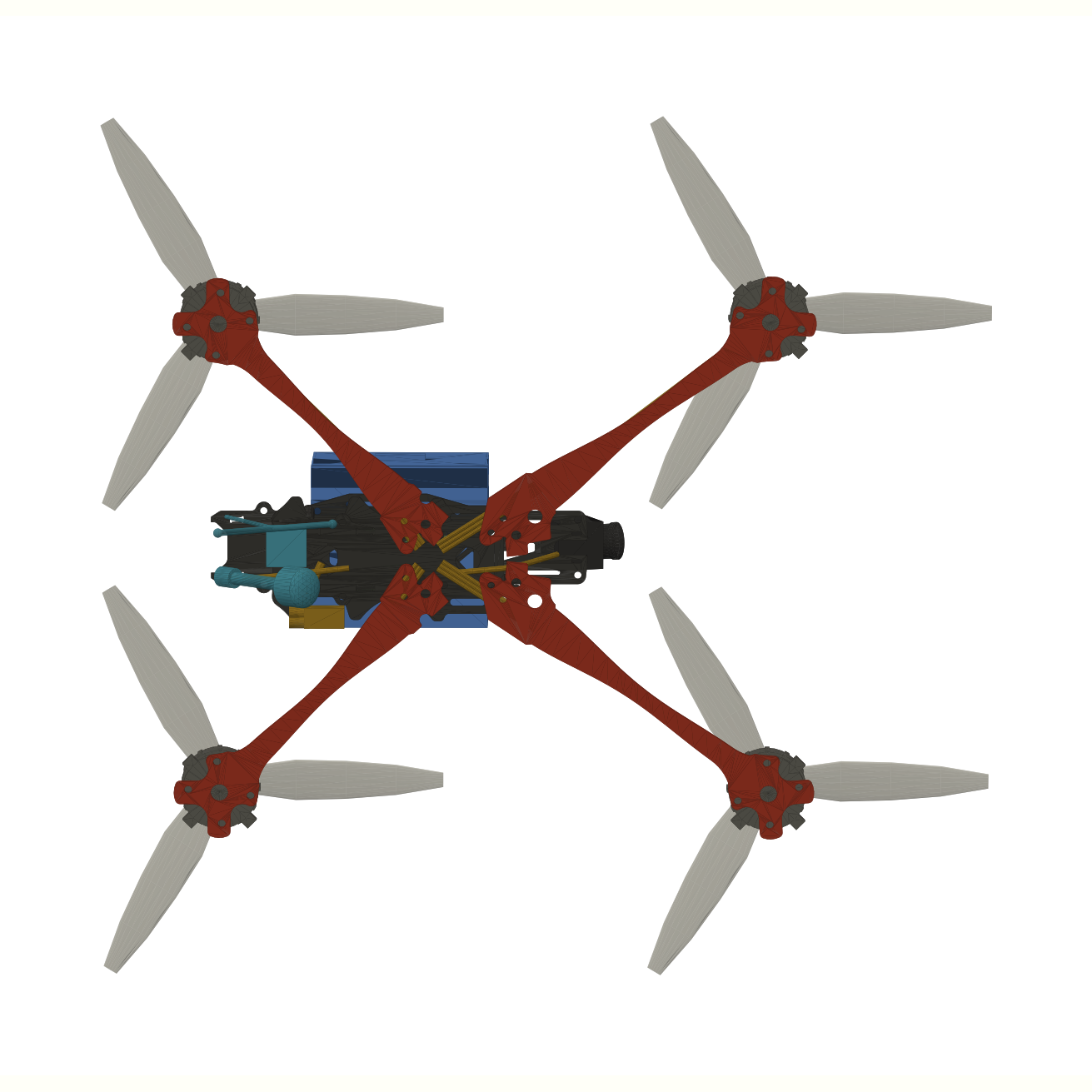
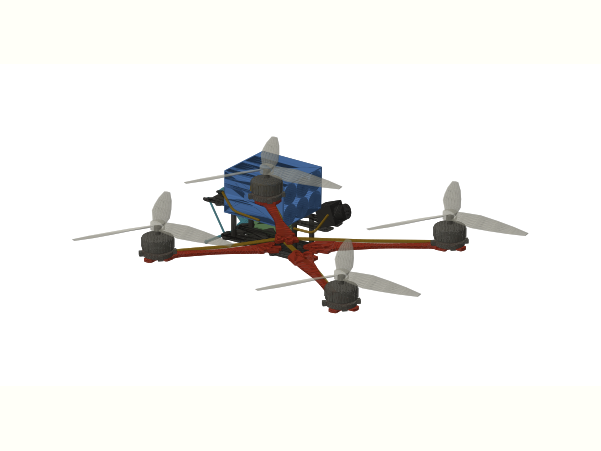
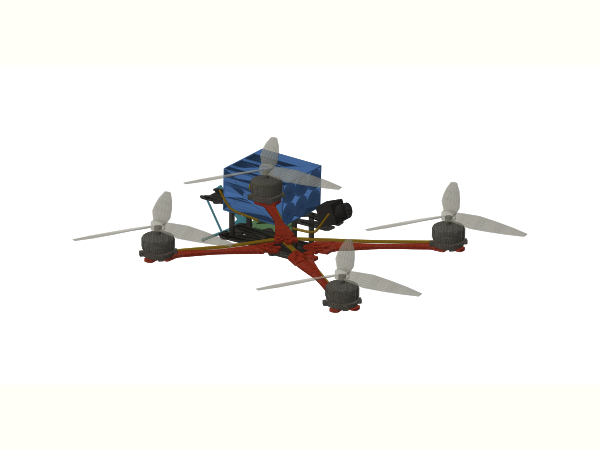
You are the designer in an automated evolutionary study of 3D-printable quadcopter frames. The geometry is the real TBS Source One V6 7-inch DeadCat, morphed by a genome; the mission is 2 km north + 2 km south at 12 m/s through six adverse-weather scenarios; fitness = mean Wh/km across scenarios + 0.5 x worst scenario (LOWER IS BETTER). The platform (battery, 2806 motors, 7x4 props, electronics) is fixed; only the frame genome varies.
GENES (name: min..max — meaning):
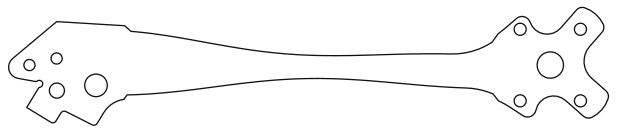
- arm_length_scale: 0.75..1.35 — arm shaft stretch (wheelbase / disk loading)
- arm_width_scale: 0.75..1.4 — arm width at shaft ends (stiffness vs drag)
- arm_waist_scale: 0.55..1.3 — extra mid-shaft narrowing (drag vs stiffness)
- arm_thickness: 0.004..0.009 — arm plate thickness in meters
- front_sweep_deg: 30.0..52.0 — front arm azimuth from nose
- rear_sweep_deg: 34.0..62.0 — rear arm azimuth from tail
- plate_length_scale: 0.85..1.3 — deck plate stretch along flight axis
- plate_width_scale: 0.85..1.25 — deck plate stretch across
- deck_gap: 0.02..0.045 — standoff length in meters (stack space, prop-deck gap)
- battery_wedge_deg: 0.0..15.0 — battery tilt on the top plate (frontal area)
- plate_thickness_scale: 0.7..1.6 — x2 mm deck plates (mass vs stiffness)
- material: 0.0..0.999 — 0-0.17 carbon plate, 0.17-0.33 PA12-CF, 0.33-0.5 PET-CF, 0.5-0.67 PLA+, 0.67-0.83 PETG, 0.83-1 ASA
BEST-PER-GENERATION TRAJECTORY (Wh/km-agg): g0 6.886, g1 6.807, g2 6.552, g3 6.547, g4 6.547, g5 6.466, g6 6.412, g7 6.412, g8 6.412, g9 6.291, g10 6.291, g11 6.274, g12 6.274, g13 6.274, g14 6.274, g15 6.257, g16 6.257, g17 6.257, g18 6.257, g19 6.257, g20 6.257 — flat (no >=0.5% improvement) for the last 11 generation(s)
CURRENT ELITES (best first):
fitness 6.257 Wh/km-agg, frame 91 g, cf_plate: genes={"arm_length_scale": 1.2731, "arm_width_scale": 0.7651, "arm_waist_scale": 0.55, "arm_thickness": 0.004, "front_sweep_deg": 33.4559, "rear_sweep_deg": 36.1765, "plate_length_scale": 0.9681, "plate_width_scale": 0.9972, "deck_gap": 0.0261, "battery_wedge_deg": 0.0, "plate_thickness_scale": 0.7, "material": 0.1254} scenarios={"calm_warm": 3.3, "cold_headwind": 3.99, "crosswind": 3.85, "gusty_light": 3.69, "hot_thin": 3.52, "storm": 4.8}
fitness 6.274 Wh/km-agg, frame 92 g, cf_plate: genes={"arm_length_scale": 1.3072, "arm_width_scale": 0.76, "arm_waist_scale": 0.55, "arm_thickness": 0.004, "front_sweep_deg": 31.8, "rear_sweep_deg": 39.3318, "plate_length_scale": 0.97, "plate_width_scale": 1.0, "deck_gap": 0.026, "battery_wedge_deg": 0.0, "plate_thickness_scale": 0.7, "material": 0.0} scenarios={"calm_warm": 3.3, "cold_headwind": 4.0, "crosswind": 3.86, "gusty_light": 3.7, "hot_thin": 3.52, "storm": 4.82}
fitness 6.284 Wh/km-agg, frame 91 g, cf_plate: genes={"arm_length_scale": 1.2628, "arm_width_scale": 0.7708, "arm_waist_scale": 0.5502, "arm_thickness": 0.004, "front_sweep_deg": 48.7313, "rear_sweep_deg": 35.7084, "plate_length_scale": 0.9764, "plate_width_scale": 1.0011, "deck_gap": 0.0232, "battery_wedge_deg": 0.0, "plate_thickness_scale": 0.7, "material": 0.0001} scenarios={"calm_warm": 3.32, "cold_headwind": 4.01, "crosswind": 3.85, "gusty_light": 3.7, "hot_thin": 3.54, "storm": 4.82}
fitness 6.286 Wh/km-agg, frame 92 g, cf_plate: genes={"arm_length_scale": 1.2981, "arm_width_scale": 0.75, "arm_waist_scale": 0.5858, "arm_thickness": 0.004, "front_sweep_deg": 33.4578, "rear_sweep_deg": 36.2882, "plate_length_scale": 0.9697, "plate_width_scale": 0.9972, "deck_gap": 0.026, "battery_wedge_deg": 0.0, "plate_thickness_scale": 0.7, "material": 0.1202} scenarios={"calm_warm": 3.31, "cold_headwind": 4.01, "crosswind": 3.87, "gusty_light": 3.71, "hot_thin": 3.53, "storm": 4.82}
fitness 6.289 Wh/km-agg, frame 92 g, cf_plate: genes={"arm_length_scale": 1.3042, "arm_width_scale": 0.7603, "arm_waist_scale": 0.55, "arm_thickness": 0.004, "front_sweep_deg": 32.1774, "rear_sweep_deg": 39.3405, "plate_length_scale": 0.9714, "plate_width_scale": 1.0101, "deck_gap": 0.026, "battery_wedge_deg": 0.0, "plate_thickness_scale": 0.7, "material": 0.0005} scenarios={"calm_warm": 3.31, "cold_headwind": 4.02, "crosswind": 3.87, "gusty_light": 3.71, "hot_thin": 3.53, "storm": 4.83}
YOUR EARLIER PROPOSALS AND HOW THEY FARED:
- g13 `e28f0289` fitness 6.840 Wh/km-agg — was: Abandon the elite family's tight-deck-gap/no-wedge/floor-thickness trait: push deck_gap near its max for maximum rotor/deck clearance, tilt the battery near its max to cut frontal area, and raise plate_thickness_scale well above the floor for a stiffer core, while holding sweep at stock and arms moderate so none of these three untested dimensions gets confounded with a sweep or mass penalty.
- g14 `03a2ffd5` fitness 6.991 Wh/km-agg — was: The elite family has converged on a minimum-mass/minimum-drag recipe (thin floor-thickness arms, near-stock sweep, tight deck gap, carbon) that has exhausted every free-mass knob without denting the storm/crosswind penalty, so this pivot abandons near-stock sweep for a genuinely wide stance (front 40, rear 48 deg) with plate scales grown per the sweep-deviation rule to test whether real aerodynami
- g14 `19c8d082` INVALID (arm tip deflection (pet_cf)) — was: Every elite uses material near 0.0 (pure carbon) because prior non-carbon attempts bundled the material switch with a heavy 'storm bruiser' stance that ate the mass budget, so this pivot isolates the material axis alone -- keep the proven elite-shaped long-arm, low-drag, near-stock-sweep geometry intact but swap to PET-CF (0.40) with plate_thickness_scale raised to 0.90 to meet the printed-materia
- g14 `e8b47537` fitness 6.371 Wh/km-agg — was: Re-test the untested battery_wedge_deg=14 frontal-area-reduction dimension, fixing the rotor-tip-clearance failure by raising arm_length_scale from the failed 0.9 to a safe 1.2 while leaving sweep, plate scales and material untouched so only the battery tilt is isolated.
- g15 `470c4fea` fitness 6.574 Wh/km-agg — was: Every elite also sits at the plate_thickness_scale floor (0.7-0.76) with a tight deck_gap (0.025-0.026) -- deck/standoff stiffness and rotor-to-deck clearance under gust loading have never been tested independently of arm geometry or a mass-adding stance change, so this pivot keeps the elite's low-drag floor-thin arms and stock sweep untouched but pushes plate_thickness_scale near its max and deck
- g15 `4e66ffd7` INVALID (arm tip deflection (petg)) — was: Re-isolate the untested tough ASA material (0.75) against the all-carbon elite family, keeping the same generous arm geometry as the failed attempt but raising deck_gap to 0.042 and trimming plate_thickness_scale to 0.85 (still above the printed-material 0.8 floor) to clear the deck/battery stack.
- g15 `a55c3afa` fitness 7.773 Wh/km-agg — was: Storm-stiffness pivot away from the elite family's thin/minimum-mass arms (wide arm_width=1.4, no waist narrowing, thick arm_thickness=0.007, carbon) that failed only on rotor/deck clearance -- fixed by raising deck_gap from the failed 0.027 to 0.04, well clear of the stack.
- g16 `a072202c` fitness 6.630 Wh/km-agg — was: Every elite sits at the arm_waist_scale floor (0.55, maximum mid-shaft narrowing) paired with minimum width -- this pivot decouples the two, isolating waist taper as its own stiffness lever by raising arm_waist_scale to 1.10 (near-constant arm width along the shaft, no pinch point to flex/resonate under storm gusts) while keeping arm_width_scale, arm_thickness, sweep and plate geometry at the elit
- g16 `cadb6dac` INVALID (arm tip deflection (petg)) — was: Prior material pivots away from carbon always failed validity (arm tip deflection / plate-web-too-thin) because they kept the elite's thin-waist thin-arm shape unchanged for a lower-modulus polymer -- this pivot properly compensates by isolating PETG (damped, tough) with arm_thickness raised to 0.0065 and arm_waist_scale relaxed to 0.80 to prevent tip deflection, and plate_thickness_scale set to 1
- g16 `f2511166` fitness 6.641 Wh/km-agg — was: Replaces the failed 14-deg rear-sweep pivot: trims the deviation to 10 deg past stock and grows plate_length/width_scale to 1.22/1.25 (above the prior 1.15/1.2 that let the tongue bolts miss the main plate) while keeping the same lean thin-arm carbon build to isolate wide-stance stiffness from mass penalties.
- g17 `232aae29` fitness 6.504 Wh/km-agg — was: Every prior storm-stiffness pivot added mass to the arms and made the aggregate worse, so instead stiffen the deck/standoff core (deck_gap raised to 0.040, plate_thickness_scale raised to 1.25) while keeping the proven thin-arm, stock-sweep, low-drag geometry completely unchanged, isolating core stiffness from arm stiffness for the first time.
- g17 `41f6a585` fitness 6.769 Wh/km-agg — was: Same PLA+ stiff-arm/thick-plate pivot as the failed design, but with deck_gap raised from 0.028 to 0.04 since the thicker plate_thickness_scale=1.0 stack consumes more of the standoff and starved rotor-to-deck clearance at the smaller gap.
- g17 `83f19dec` fitness 6.475 Wh/km-agg — was: Isolate pure aerodynamic stance from the mass penalty that sank every prior wide-sweep attempt: push both sweeps well past stock (front +12, rear +14) with plate scales grown generously (1.28/1.24) to keep the tongue bolts safely seated, while leaving the elite's thin floor-mass carbon arms completely untouched.
- g18 `7adc86c1` fitness 6.646 Wh/km-agg — was: Stake out a genuinely wide-stance aero region by combining far-from-stock sweeps (front 43, rear 52, plate scales grown per the 0.1-per-5-deg rule) with an untested 8-deg battery wedge, isolating a combined frontal/side-profile reduction strategy for crosswind and cold_headwind that no prior single-axis sweep or wedge pivot tested together.
- g18 `d8d770d5` INVALID (arm tip deflection (asa)) — was: Switch away from carbon to a tough, damped ASA build (material 0.9) with thickness, width and waist properly compensated (arm_thickness 0.006, waist relaxed to 0.85 to remove a pinch-point resonance node, plate_thickness_scale 1.0) to test whether damage tolerance under gust loading can genuinely cut the storm penalty that dominates the fitness function, unlike prior uncompensated material pivots
- g19 `0e35d1c3` fitness 6.588 Wh/km-agg — was: Same combined wide-stance-plus-battery-wedge frontal-area pivot as the failed design, but grow plate_length/width_scale to 1.28/1.24 -- the pairing already proven to keep the tongue bolts seated at this exact +12.6/+14 deg sweep deviation -- instead of the too-thin 1.22/1.18 that let them miss the main plate.
- g19 `624da8bb` INVALID (arm resonance with rotor 1P) — was: The elite family shares a floor-thickness, minimum-mass build where every attempt to add stiffness got starved by mass penalty — so isolate the opposite extreme (near-max arm width/waist/thickness plus near-max plate thickness, sweep held at stock and deck_gap generously raised for stack clearance) to see whether real structural stiffness ever pays off for storm once mass is not being traded piece
- g20 `21664820` fitness 8.018 Wh/km-agg — was: The elite family's floor-thickness/min-width/min-waist arms have exhausted every mass-reduction lever without denting the storm penalty; combine the two previously-isolated promising stiffness levers -- waist decoupling (arm_waist_scale=1.2, no pinch point, scored 6.630 alone) and deck/core stiffening (plate_thickness_scale=1.35, deck_gap=0.040, scored 6.504 alone) -- into one genuinely stiff-arm,
- g20 `cc53cd9d` fitness 6.514 Wh/km-agg — was: Every material pivot away from carbon has failed validity because it kept the elite's thin-shell dimensions unchanged; properly compensate PA12-CF's higher density and lower stiffness this time (arm_thickness raised to 0.006 to fix the repeated pa12_cf tip-deflection failure, plate_thickness_scale raised to 1.0, well above the 0.8 printed-material floor) to cleanly test whether its damage toleranc
- g20 `f45e862c` fitness 6.619 Wh/km-agg — was: Battery wedge is the only frontal-area lever that ever came close to the elite in isolation (wedge=14 scored 6.371) while every symmetric sweep-widening attempt lost to its own plate-mass penalty, so push wedge to its true max (15) and pair it with an asymmetric tight-nose/wide-tail sweep (front at the 30 deg floor, rear opened to 46) to shift the aerodynamic center for storm/crosswind stability i
RECENT INVALID-DESIGN REASONS (histogram): {"plate web too thin (plate_main 0.32 mm, stock 1.90 mm)": 1, "deck gap too small for FC/ESC stack": 13, "plate web too thin (plate_main 0.66 mm, stock 1.90 mm)": 1, "plate web too thin (plate_main 1.06 mm, stock 1.90 mm)": 1, "arm tongue bolts miss the main plate": 12, "plate web too thin (plate_main 1.48 mm, stock 1.90 mm)": 1, "plate web too thin (plate_main 0.59 mm, stock 1.90 mm)": 1, "rotor too close to deck/battery": 12, "arm resonance with rotor 1P": 3, "plate web too thin (plate_top 1.25 mm, stock 1.75 mm)": 2, "rotor disks overlap (tip clearance)": 7, "plate web too thin (plate_mid 1.11 mm, stock 1.47 mm)": 5, "plate web too thin (plate_main 0.84 mm, stock 1.90 mm)": 2, "arm root tongues collide on the main plate": 17, "plate web too thin (plate_main 0.78 mm, stock 1.90 mm)": 1, "plates too thin for pet_cf (1.5 < 1.6 mm)": 1, "plate web too thin (plate_main 0.85 mm, stock 1.90 mm)": 2, "plate web too thin (plate_main 0.97 mm, stock 1.90 mm)": 1, "plates too thin for pa12_cf (1.4 < 1.6 mm)": 7, "plate web too thin (plate_main 0.73 mm, stock 1.90 mm)": 1, "arm tip deflection (pa12_cf)": 5, "plate web too thin (plate_main 1.44 mm, stock 1.90 mm)": 1, "plates too thin for pa12_cf (1.5 < 1.6 mm)": 2, "plate web too thin (plate_main 1.37 mm, stock 1.90 mm)": 1, "plates too thin for pa12_cf (1.6 < 1.6 mm)": 1, "plate web too thin (plate_main 1.24 mm, stock 1.90 mm)": 1, "plate web too thin (plate_main 1.23 mm, stock 1.90 mm)": 1, "plate web too thin (plate_main 1.18 mm, stock 1.90 mm)": 1, "plate web too thin (plate_top 1.02 mm, stock 1.75 mm)": 1, "plate web too thin (plate_main 0.37 mm, stock 1.90 mm)": 1, "plate web too thin (plate_main 1.20 mm, stock 1.90 mm)": 1, "plate web too thin (plate_top 1.00 mm, stock 1.75 mm)": 1, "plate web too thin (plate_main 0.99 mm, stock 1.90 mm)": 1, "plates too thin for pla_plus (1.5 < 1.6 mm)": 1, "arm tip deflection (pet_cf)": 2, "plate web too thin (plate_main 1.29 mm, stock 1.90 mm)": 1, "plate web too thin (plate_mid 1.12 mm, stock 1.47 mm)": 2, "arm tip deflection (petg)": 2, "plate web too thin (plate_main 1.45 mm, stock 1.90 mm)": 2, "plate web too thin (plate_main 1.02 mm, stock 1.90 mm)": 1, "plate web too thin (plate_top 1.34 mm, stock 1.75 mm)": 1, "plate web too thin (plate_top 1.38 mm, stock 1.75 mm)": 1, "plate web too thin (plate_main 0.21 mm, stock 1.90 mm)": 1, "plate web too thin (plate_main 0.51 mm, stock 1.90 mm)": 1, "plate web too thin (plate_main 1.43 mm, stock 1.90 mm)": 1, "plate web too thin (plate_main 1.12 mm, stock 1.90 mm)": 1, "arm tip deflection (asa)": 1, "plate web too thin (plate_top 1.39 mm, stock 1.75 mm)": 1, "plate web too thin (plate_top 1.30 mm, stock 1.75 mm)": 1}
SCENARIO NOTES: storm (8 m/s wind, severe gusts, rain) dominates worst-case; cold_headwind rewards low frontal drag; hot_thin (thin air) rewards low mass; crosswind rewards a small side profile.
THE SEARCH HAS PLATEAUED: the best-so-far has not improved significantly for 11 generation(s). This is a PIVOT round. Take a step back: reason about WHY the current elite family has stopped improving — what shared trait is this local optimum built on, and what does the per-scenario data say it costs? Then propose exactly 3 PIVOTAL designs that abandon that trait and stake out genuinely different regions of the genome space. Do NOT refine the elites — a pivot that lands near them is a wasted round. Respect the hard constraints implied by the failure histogram. Known couplings: the deck gap must exceed 0.023 m for the FC stack; arm tongues collide when both sweeps sit at their minimums with wide arms; the tongue BOLTS must stay on the main plate -- sweeps far from stock (front 31.4, rear 36.0) need plate_length_scale/plate_width_scale to grow with them (rule of thumb: keep sweeps within ~6 deg of stock unless you also raise the plate scales by ~0.1 per extra 5 deg); the FC-stack holes stay PINNED while the plates scale, so plate scales below ~0.95 crush the material webs between holes and cutouts (min 80% of the stock web is enforced); and printed materials (anything but cf_plate) need plate_thickness_scale >= 0.8 (>= 1.6 mm plates).
Respond with a JSON object of the shape:
{"proposals": [{"rationale": "<one sentence>", "genes": {"arm_length_scale": <float>, "arm_width_scale": <float>, "arm_waist_scale": <float>, "arm_thickness": <float>, "front_sweep_deg": <float>, "rear_sweep_deg": <float>, "plate_length_scale": <float>, "plate_width_scale": <float>, "deck_gap": <float>, "battery_wedge_deg": <float>, "plate_thickness_scale": <float>, "material": <float>}}, ...]}