“The snuggle is real”: — evolving quadcopter frame geometry for Wh/km, with Claude as an occasional co-designer
I let a genetic algorithm loose on the geometry of a 7-inch quadcopter frame — the real, open-source Source One V6 plate drawings, morphed by fourteen genes and flown through six simulated weather scenarios, with Claude sitting in every few generations to propose designs from the run’s own telemetry.
the bottom line: we evolved the champion to fly 16% more efficiently (Wh/km) across six weather scenarios
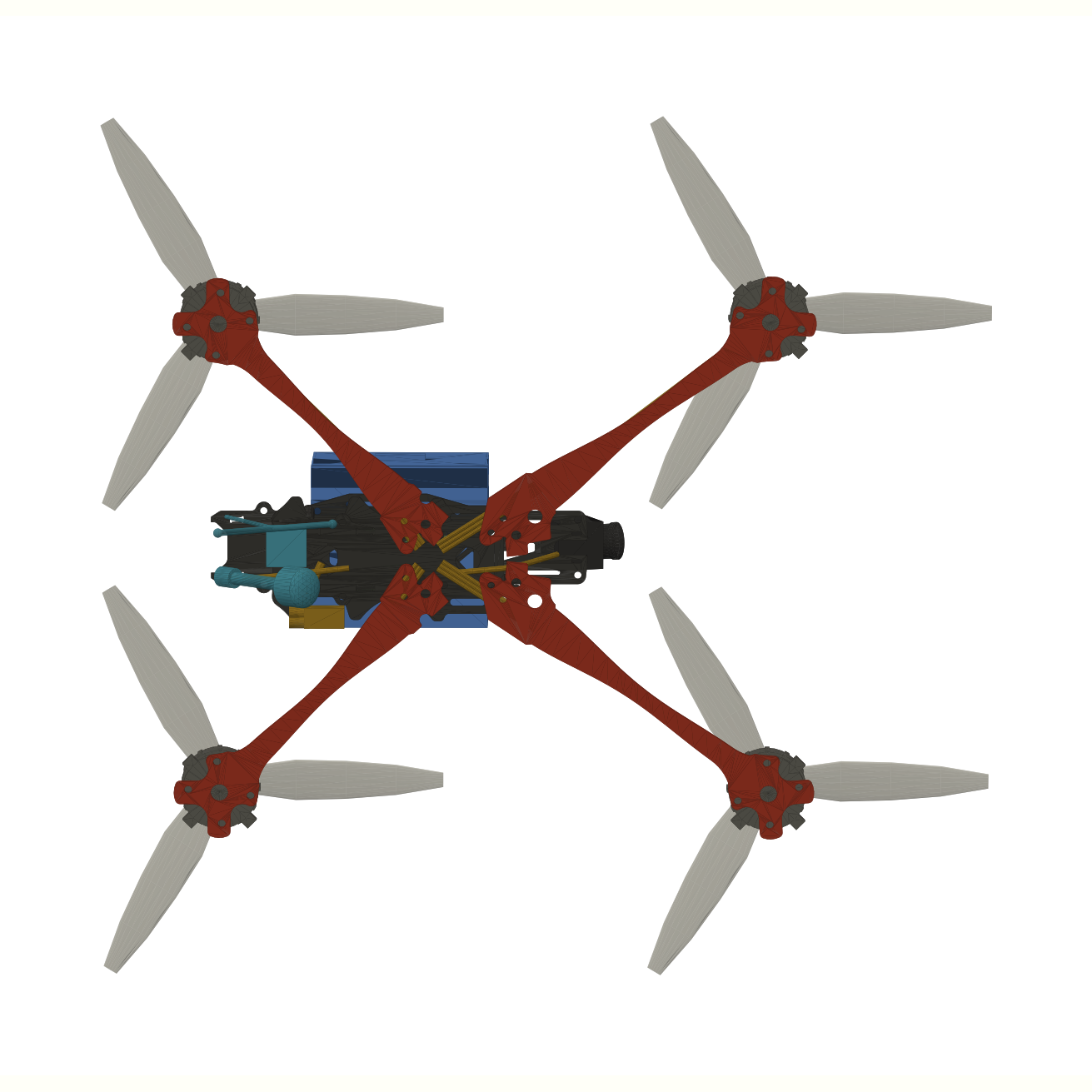
Evolved part: the four arms — length, width, waist, thickness and sweep genes reshape them.deck plates + standoffsdeck plates + standoffs
Evolved part: the stacked deck plates and standoffs — plate size, thickness and deck gap genes reshape them.fixed kit:batterybattery
Fixed kit, identical on every candidate — drawn in the 3D model for context only; evolution never changes it.FC/ESC stackFC/ESC stack
Fixed kit, identical on every candidate — drawn in the 3D model for context only; evolution never changes it.wiring/XT60wiring/XT60
Fixed kit, identical on every candidate — drawn in the 3D model for context only; evolution never changes it.motorsmotors
Fixed kit, identical on every candidate — drawn in the 3D model for context only; evolution never changes it.prop disksprop disks
Fixed kit, identical on every candidate — drawn in the 3D model for context only; evolution never changes it.
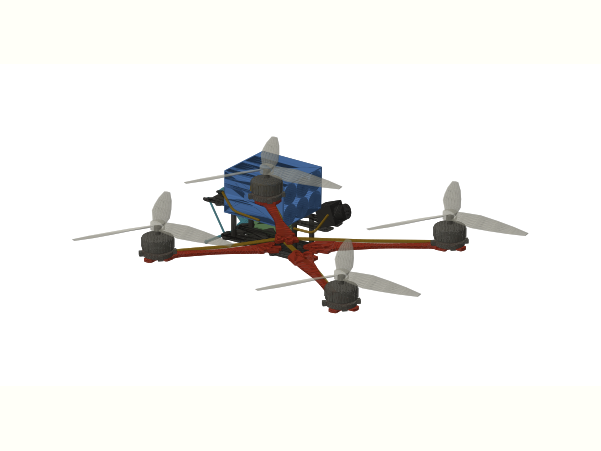
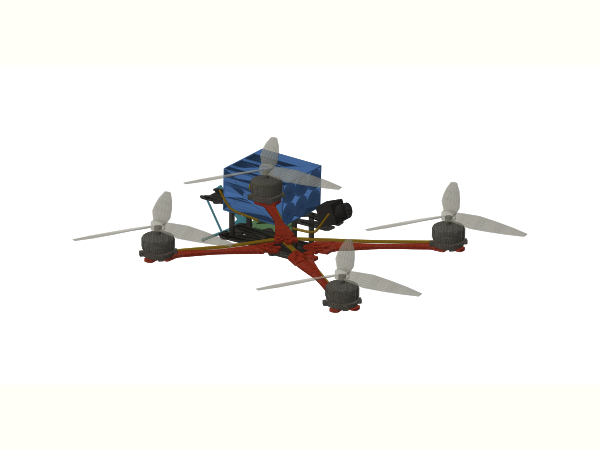
performance: the champion flying all 6 weather scenarios
the champion’s actual scored flights, replayed from simulation telemetry. Top row: airflow streamlines colored by speed (dark purple slow, yellow fast). Bottom row: surface pressure in pascals (deep red is high-pressure stagnation, deep blue is suction). Drag any box and the whole row orbits together. The view candidate performance button above opens the full-screen replay with live telemetry.
+5 more scenarios on desktop — too much for a phone’s WebGL budget to render at once
+5 more scenarios on desktop — too much for a phone’s WebGL budget to render at once
the lineage trail: 80 generations, superimposed
every ancestor on the champion’s line, from the baseline to the winner, drawn on top of each other — the winner solid, each ancestor a fainter gray ghost the further back it goes. Evolved parts only, so the shape change itself is what reads.
watch it evolve: the same line, step by step
1061 candidate frames flew six weather scenarios across 80 generations, breeding lower-energy designs each round. This replay walks the champion’s own line, from the baseline to the winner — the current step solid, the next in line a gray ghost. Press play or click a thumbnail.
the family tree: where the champion’s bloodline runs through the whole run
every candidate of the run, newest generation at the top, in two lenses — performance on the left, breeding on the right — with the champion’s full ancestry highlighted. Hover any node to inspect it, click to pin another lineage (esc releases); the family tree page tells the whole story, and the research log has every candidate in full.
Performance column only: GRAY nodes are evaluated candidates, BLACK nodes set a new best-so-far when evaluated -- the gallery chart's exact dot language. The breeding column keeps every node neutral on purpose.invalidred ×
Invalid design (performance column): it violated a hard constraint (tongue collision, stack fit, rotor clearance, structural failure...) or failed a flight scenario -- the gallery's red ×. Fitness = infinity; never selected as a parent.championchampion ring
The accent ring is the RUN CHAMPION -- the lowest aggregate Wh/km of the whole run, the gallery's red-outlined card (performance column).claude-designedclaude-designed
Claude-designed: proposed by a designer round (opening, scheduled, or pivot), born from a prompt rather than parents -- so it has no incoming edge; the purple halo is its mark, the same purple the gallery uses. Carried-over copies keep a thinner halo.node size = born / carriednode size
Large node = the candidate was BORN in that generation. Small node = an elite carried over unchanged, shown again in a later generation's population. Applies in both columns.
Simulated Binary Crossover: the child's genes are sampled around its two parents' values (closer for higher eta) -- the digital analogue of breeding two good frames.pivotpivot
Patience exhausted: after 6 generations without a >=0.5% improvement, children are bred from a tournament winner and a FAR parent (the most genetically distant still-decent candidate in the run's history) under boosted mutation, to break the plateau.claude-designedclaude-designed
Claude-designed: proposed by a designer round (opening, scheduled, or pivot), born from a prompt rather than parents -- so it has no incoming edge; the purple halo is its mark, the same purple the gallery uses. Carried-over copies keep a thinner halo.mutationmutation
Gaussian noise on a subset of genes. Its sigma decays per generation, so early search explores and late search fine-tunes.immigrantimmigrant
A fresh random genome injected (~10% of non-elite slots) to keep genetic diversity from collapsing. No parents, so no edge -- the small gold caret above a node marks the injection.elite carry-overelite carry-over
Elite carry-over: the top candidates pass unchanged into the next generation so the best design can never be lost. The dashed line follows one candidate surviving; it reappears as a SMALL node in the later row.seedseed
Generation 0: the real Source One V6 baseline plus random genomes -- no parents.cmaescmaes
Sampled from CMA-ES's adapted Gaussian (the flag-gated alternative optimizer). No discrete parents; provenance is the distribution's mean and sigma.purple row = claude roundclaude generation
A light purple row means a Claude designer round shaped this generation -- the same purple band the gallery chart shows; the g-label carries a purple ✦. The round's prompt and proposals are in the gallery's generation panel.pivot generationpivot generation
A teal dashed rule above the row (and ⟳ on the g-label) marks a pivot generation: patience ran out and half the non-elite slots were bred with far parents under boosted mutation.node size = born / carriednode size
Large node = the candidate was BORN in that generation. Small node = an elite carried over unchanged, shown again in a later generation's population. Applies in both columns.
build it: the champion as five flat templates
the exact parts the champion scored with, laid flat in print/cut orientation and drawn to one shared scale — bolt holes, lightening cutouts and all.
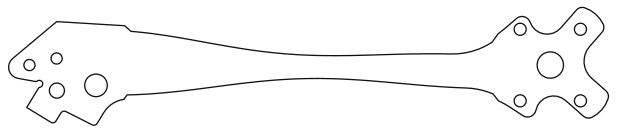
print one mirrored
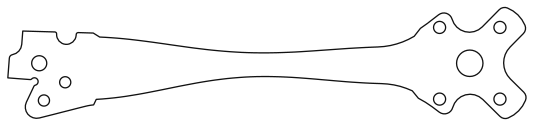
print one mirrored
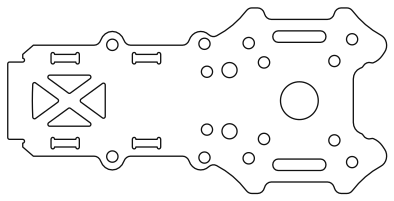
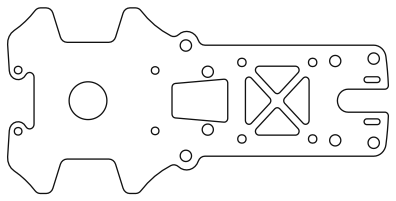
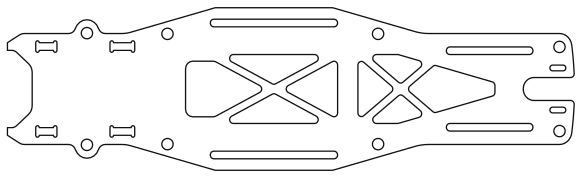
Print or cut every part in CNC-cut carbon-fiber laminate — arms 2.5 mm thick, deck plates 1.3 mm. The STLs are already extruded to final thickness; the SVGs are true-scale (mm) for CNC or laser cutting. Standoffs, screws and electronics are the stock Source One kit’s. The arm-clamp bolt holes in the main and mid plates are re-cut where the swept arms actually sit, so the arms bolt straight on. Also: the assembled frame as one solid, for reference and scale checks, and a build README.
Evolved part: the four arms — length, width, waist, thickness and sweep genes reshape them.deck plates + standoffsdeck plates + standoffs
Evolved part: the stacked deck plates and standoffs — plate size, thickness and deck gap genes reshape them.fixed kit:batterybattery
Fixed kit, identical on every candidate — drawn in the 3D model for context only; evolution never changes it.FC/ESC stackFC/ESC stack
Fixed kit, identical on every candidate — drawn in the 3D model for context only; evolution never changes it.wiring/XT60wiring/XT60
Fixed kit, identical on every candidate — drawn in the 3D model for context only; evolution never changes it.motorsmotors
Fixed kit, identical on every candidate — drawn in the 3D model for context only; evolution never changes it.prop disksprop disks
Fixed kit, identical on every candidate — drawn in the 3D model for context only; evolution never changes it.