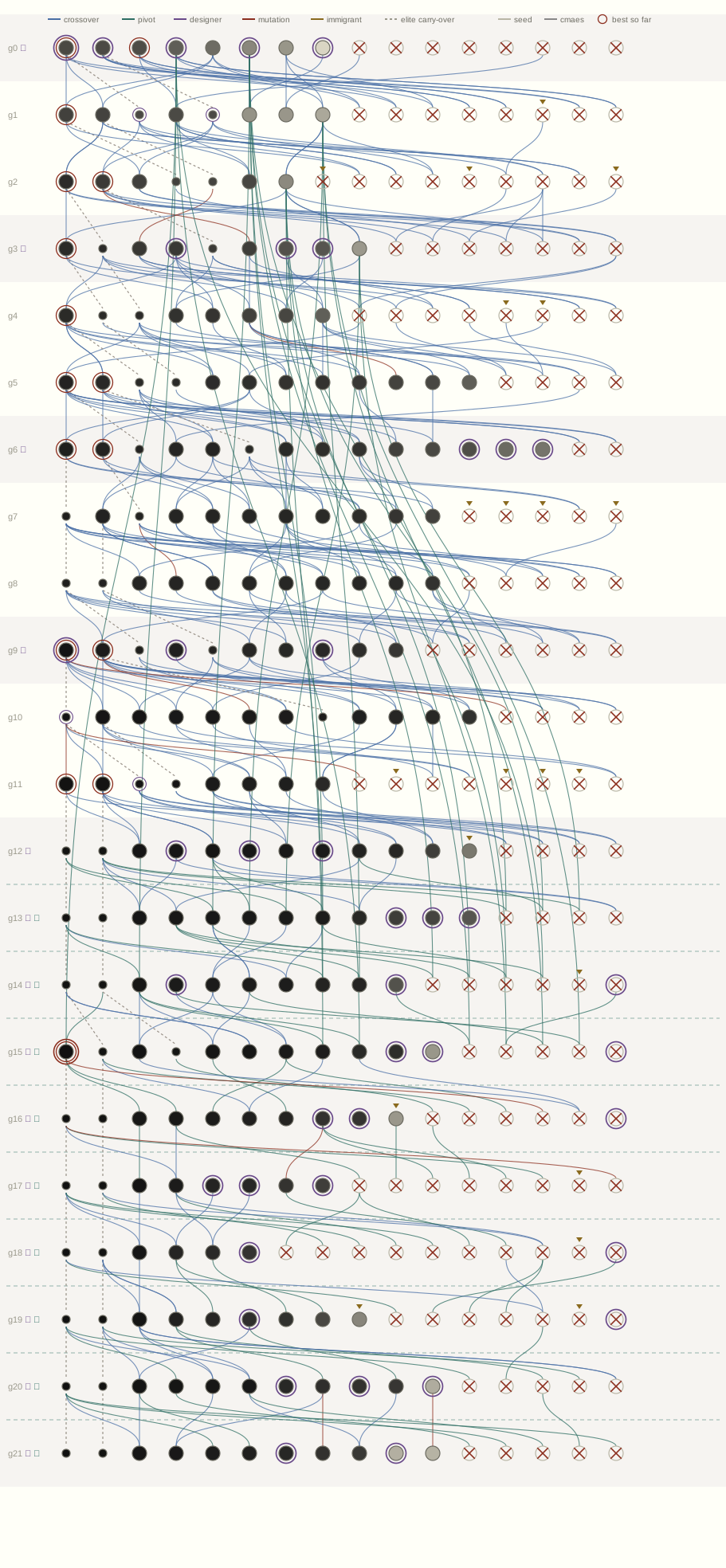
the same family tree twice, one row per generation with
the LATEST at the top, candidates ordered best→worst; the run
champion’s ancestry starts highlighted. The LEFT column speaks the gallery
chart’s performance language: gray = candidate,
black = best-so-far, red × = invalid,
accent ring = the run champion,
purple halo = claude-designed. The RIGHT column speaks
the breeding language: neutral nodes, operator-colored edges, a gold caret
for immigrant injections, purple rows for claude designer rounds, teal
dashed rules for pivot generations. Edges rest muted in both columns
— hover any node on either side to light its full ancestry in both,
click to pin (esc releases). Node size everywhere:
large = born that generation,
small = elite carried over.
performance — who’s good
candidate / best so farnode status Performance column only: GRAY nodes are evaluated candidates, BLACK nodes set a new best-so-far when evaluated -- the gallery chart's exact dot language. The breeding column keeps every node neutral on purpose.invalidred × Invalid design (performance column): it violated a hard constraint (tongue collision, stack fit, rotor clearance, structural failure...) or failed a flight scenario -- the gallery's red ×. Fitness = infinity; never selected as a parent.championchampion ring The accent ring is the RUN CHAMPION -- the lowest aggregate Wh/km of the whole run, the gallery's red-outlined card (performance column).claude-designedclaude-designed Claude-designed: proposed by a designer round (opening, scheduled, or pivot), born from a prompt rather than parents -- so it has no incoming edge; the purple halo is its mark, the same purple the gallery uses. Carried-over copies keep a thinner halo.node size = born / carriednode size Large node = the candidate was BORN in that generation. Small node = an elite carried over unchanged, shown again in a later generation's population. Applies in both columns.
breeding — how they were made
crossovercrossover Simulated Binary Crossover: the child's genes are sampled around its two parents' values (closer for higher eta) -- the digital analogue of breeding two good frames.pivotpivot Patience exhausted: after 6 generations without a >=0.5% improvement, children are bred from a tournament winner and a FAR parent (the most genetically distant still-decent candidate in the run's history) under boosted mutation, to break the plateau.claude-designedclaude-designed Claude-designed: proposed by a designer round (opening, scheduled, or pivot), born from a prompt rather than parents -- so it has no incoming edge; the purple halo is its mark, the same purple the gallery uses. Carried-over copies keep a thinner halo.mutationmutation Gaussian noise on a subset of genes. Its sigma decays per generation, so early search explores and late search fine-tunes.immigrantimmigrant A fresh random genome injected (~10% of non-elite slots) to keep genetic diversity from collapsing. No parents, so no edge -- the small gold caret above a node marks the injection.elite carry-overelite carry-over Elite carry-over: the top candidates pass unchanged into the next generation so the best design can never be lost. The dashed line follows one candidate surviving; it reappears as a SMALL node in the later row.seedseed Generation 0: the real Source One V6 baseline plus random genomes -- no parents.cmaescmaes Sampled from CMA-ES's adapted Gaussian (the flag-gated alternative optimizer). No discrete parents; provenance is the distribution's mean and sigma.purple row = claude roundclaude generation A light purple row means a Claude designer round shaped this generation -- the same purple band the gallery chart shows; the g-label carries a purple ✦. The round's prompt and proposals are in the gallery's generation panel.pivot generationpivot generation A teal dashed rule above the row (and ⟳ on the g-label) marks a pivot generation: patience ran out and half the non-elite slots were bred with far parents under boosted mutation.node size = born / carriednode size Large node = the candidate was BORN in that generation. Small node = an elite carried over unchanged, shown again in a later generation's population. Applies in both columns.
The same graph is exported as Graphviz DOT
(lineage.dot) and raw SVG
(lineage.svg); ancestry of any candidate:
airloom lineage <hash>.