Everything I publish, in the order I published it: dispatches from Twitter, videos from YouTube and notes from my vault, archived here in full — text, images, video and links — so they outlive the platforms.
LOL, got 100% nerd-sniped by my friend Sönke this week and wound up building a small spaceship.
On Monday he's like "Hey, what if you found obscure seed phrases embedded in public texts? You'd only need to remember the name of the book and the paragraph and go from there."
I honestly could care less about crypto(currencies) and I'm 100% sure this is like cryptanalysis 101. But, yeah, it seemed like an interesting problem anyways.
First, I downloaded a few hundred books from Gutenberg, wrote a ruby script and found BIP39 word sequences with a tolerable buffer for filler-words.
Then, I was like, okay, gotta now check them against actual addresses. Downloaded a list of funded ETH addresses. Wrote the checker in ruby. Ran it. No hits but this was now definitely weirdly interesting.
Because: And what if I downloaded the whole pg19 text corpus to scan! And what if I'd add BTC addresses! And what if I checked every permutation of the seed phrase!
Everything got really slow once I got to processing 12G of raw text for finding sequences and then checking a few million candidates with 44.000+ variations per candidate.
So, let's rewrite this into C! And since I've got 16 cores, let's parallelize this puppy! And since it's a MacBook, let's use GCD! Optimize all the things!
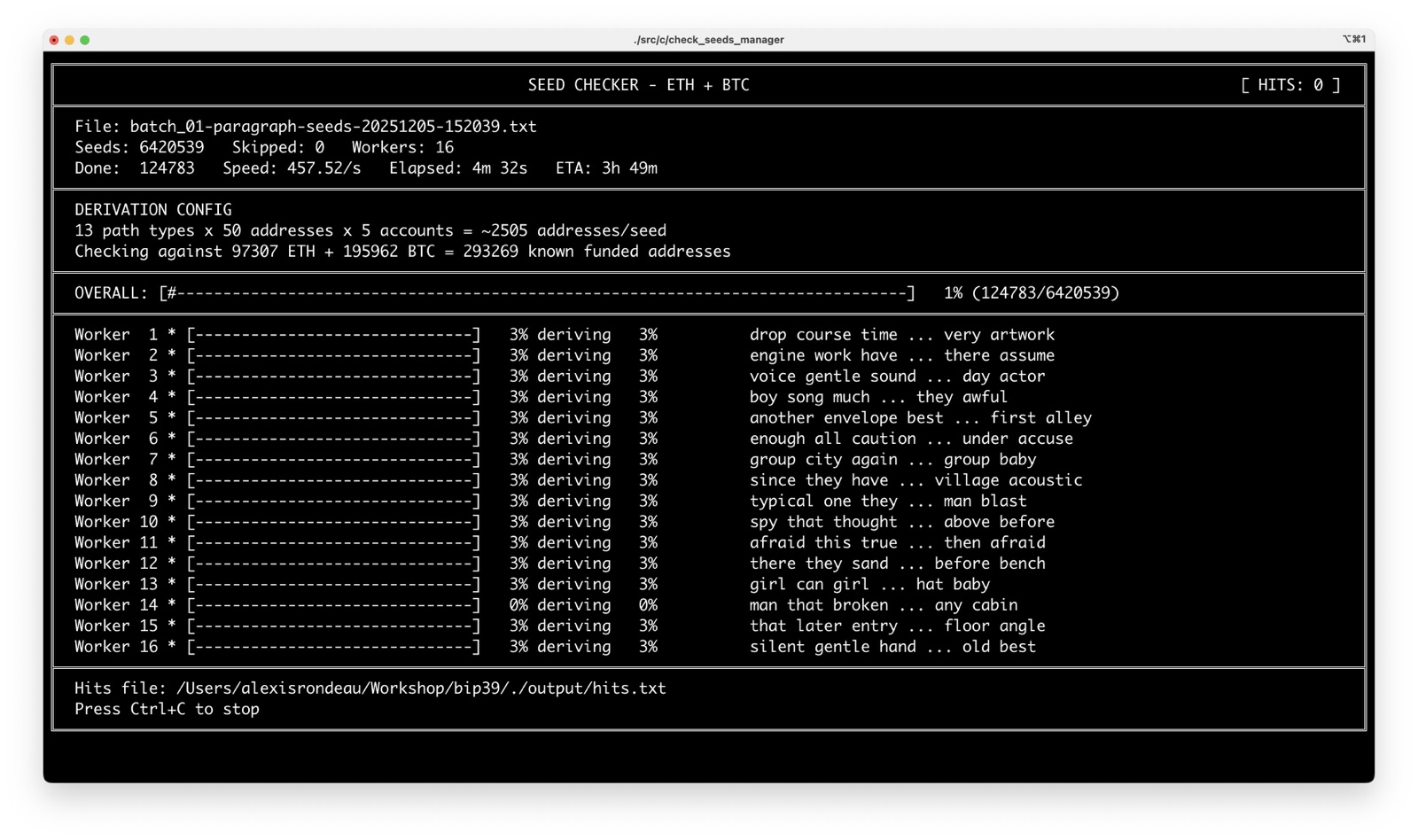
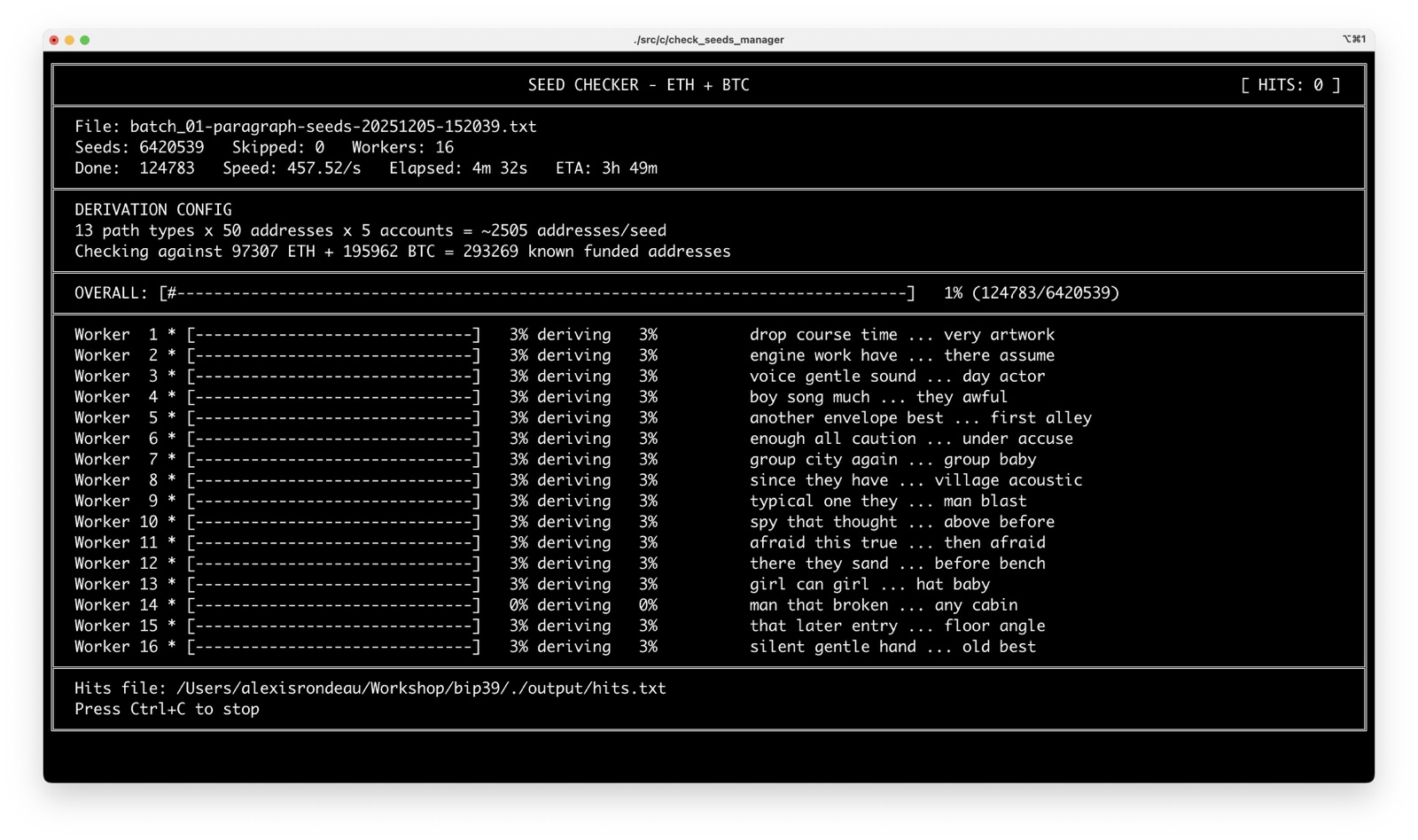
Lol, so NOW this thing is so fucking FAST. Takes four minutes to go through the full pg19 corpus and generates 64,205,390 "interesting" seed phrases. The fully parallelized checker (see Terminal screenshot) processes 460 derived addresses per second.
I really don't care if I get a match or not. I feel like I started with building a canoo and wound up with a spaceship is in itself just the best thing in the world.
Anyways. Just wanted to share this. If anyone wants, I can put the whole thing on github, too. Let me know!
LOL, forgot to mention.
There was a short-lived exploration into writing a Metal shader for a part of the pre-processing. I got pretty far but I backed out because it was slower than running things in parallel.
LOL, got 100% nerd-sniped by my friend Sönke this week and wound up building a small spaceship.
On Monday he's like "Hey, what if you found obscure seed phrases embedded in public texts? You'd only need to remember the name of the book and the paragraph and go from there."
I honestly could care less about crypto(currencies) and I'm 100% sure this is like cryptanalysis 101. But, yeah, it seemed like an interesting problem anyways.
First, I downloaded a few hundred books from Gutenberg, wrote a ruby script and found BIP39 word sequences with a tolerable buffer for filler-words.
Then, I was like, okay, gotta now check them against actual addresses. Downloaded a list of funded ETH addresses. Wrote the checker in ruby. Ran it. No hits but this was now definitely weirdly interesting.
Because: And what if I downloaded the whole pg19 text corpus to scan! And what if I'd add BTC addresses! And what if I checked every permutation of the seed phrase!
Everything got really slow once I got to processing 12G of raw text for finding sequences and then checking a few million candidates with 44.000+ variations per candidate.
So, let's rewrite this into C! And since I've got 16 cores, let's parallelize this puppy! And since it's a MacBook, let's use GCD! Optimize all the things!
Lol, so NOW this thing is so fucking FAST. Takes four minutes to go through the full pg19 corpus and generates 64,205,390 "interesting" seed phrases. The fully parallelized checker (see Terminal screenshot) processes 460 derived addresses per second.
I really don't care if I get a match or not. I feel like I started with building a canoo and wound up with a spaceship is in itself just the best thing in the world.
Anyways. Just wanted to share this. If anyone wants, I can put the whole thing on github, too. Let me know!
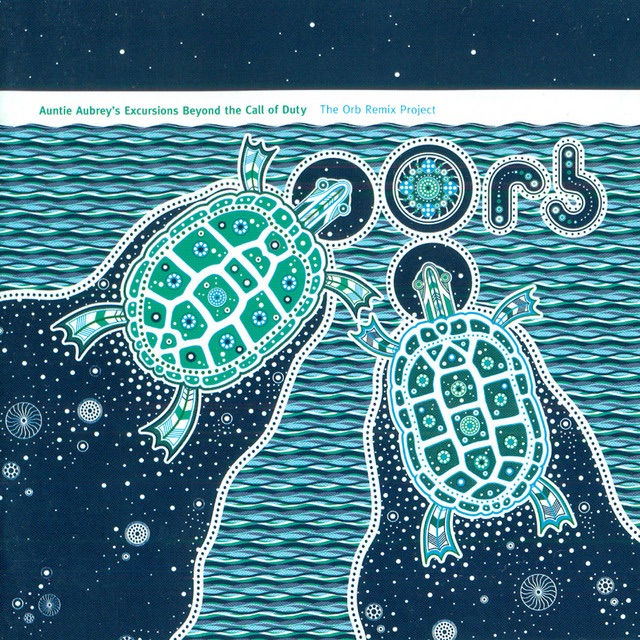
“As I was floating on the surface, I realized something: When the turtle was swimming, it linked its movements to the movements of the water. When a wave was coming at him, he would float, and paddle just enough to hold his position. When the pull of the wave was from behind him though, he’d paddle faster, so that he was using the movement of the water to his advantage. The turtle never fought the waves. Instead, he used them.”
A notion from "The Cafe on the Edge Of the World" that I remembered (and found the actual quote thanks to a quick @ChatGPTapp deep research) - Cover from The Orb's "Auntie Aubrey's Excursions Beyond The Call Of Duty - The Orb Remix Project - Part 1"
I wish there was a simple way to temporarily switch "following-bubbles" on Twitter. I'd love to see what, say, sama or pg see when they open their feed. Does this exist?
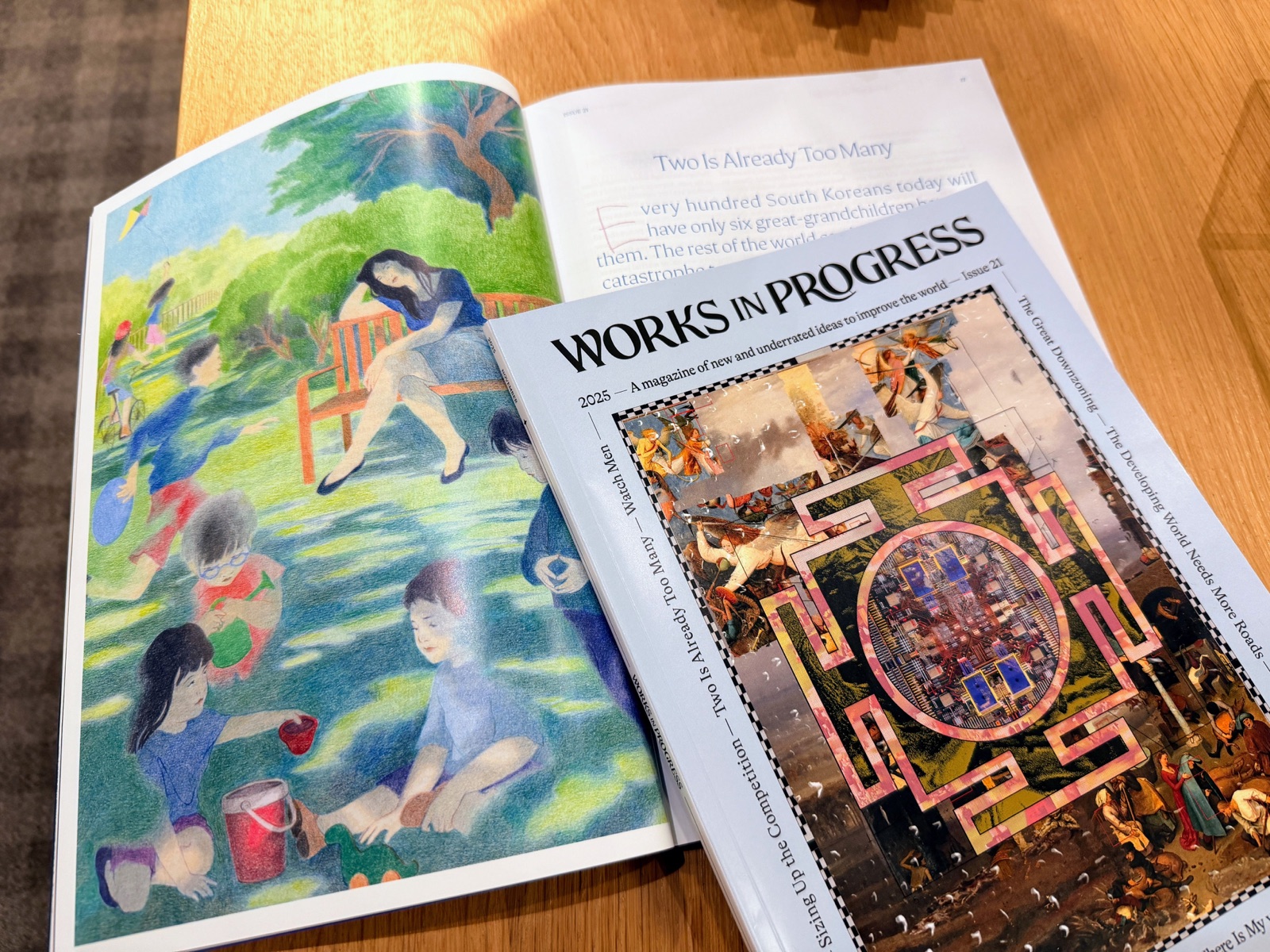
The first print issue of Works In Progress is landing on people's doorsteps today!
Over the next week or so, our thousands of subscribers, everywhere from Alaska to Australia, should be receiving their first copy. We are trying to make the most beautiful physical magazine on the planet, and I am very excited about how we've started.
This issue has pieces on inflatable space stations (which you can read online today – t.co/kP1F46xUtO), the war between the Swiss and Japanese watch industries, the "great downzoning" in the world's cities, and on whether Ancient Greek and Roman statues were really painted as badly as museums claim (perhaps not). And much more.
I hope you all enjoy it! And if you'd like to get a copy of this edition, you can subscribe here and you'll be sent this most recent copy, along with the rest of your year's subscription as it comes out: t.co/hfTpdnnVjF
Seventy years after John von Neumann’s essay “Can We Survive Technology?”, the questions he posed feel more urgent than ever.
On Thursday 4 December, I'm chairing an expert panel discussion at the Hungarian Embassy in London on what that essay means to us now. You're invited! t.co/AW7kL60SaH
@TryAstroApp – Used Astro today to track, evaluate and adjust keywords for Pudding v1.0.1. Doubling down on those that work and replace those that don't. Very exciting :)
^ This is why I really don't engage in those FUD-dy "AI is just a bubble, it's too early to tell, it can't replace software engineers because blablabla..." conversations anymore.
AI works. Super, super well. It's one of the best co-workers I've ever had. What are y'all yapping about?
On the other hand I ALSO don't engage in the other, equally dark FUD-dy "AI works so well but it's soooo complicated to get it right. Oh my gawd, the only way you'll survive this is by taking my course" hidden agenda sales pitches.
AI works AND it is completely accessible to everyone.
There is NO secret sauce to get started. And there's no secret sauce and to get good either.
Second 🌕 moonwalk🚶🏻project successfully shipped to production:
-> Vibe code until prototype feels right
-> Turn prototype into markdown specification
-> Throw away vibe'd code
-> Keep specification
-> Feed specification to XP/TDD agents
-> Done
^ This is why I really don't engage in those FUD-dy "AI is just a bubble, it's too early to tell, it can't replace software engineers because blablabla..." conversations anymore.
AI works. Super, super well. It's one of the best co-workers I've ever had. What are y'all yapping about?
A good solution would not ignore reality but would try to figure out a way to keep the good and limit the bad - Josh proposes one such idea, at least for now: t.co/Qy8YdEf8TS
Hi Ethan, I published a Mac OS app recently that basically uses the editing history of a text as a uniquely human indicator.
I know that this is also not the full, final, solution, but it's a first experiment and can help figure this out.
0:00:00 – Explaining model jaggedness
0:09:39 - Emotions and value functions
0:18:49 – What are we scaling?
0:25:13 – Why humans generalize better than models
0:35:45 – Straight-shotting superintelligence
0:46:47 – SSI’s model will learn from deployment
0:55:07 – Alignment
1:18:13 – “We are squarely an age of research company”
1:29:23 – Self-play and multi-agent
1:32:42 – Research taste
Look up Dwarkesh Podcast on YouTube, Apple Podcasts, or Spotify. Enjoy!